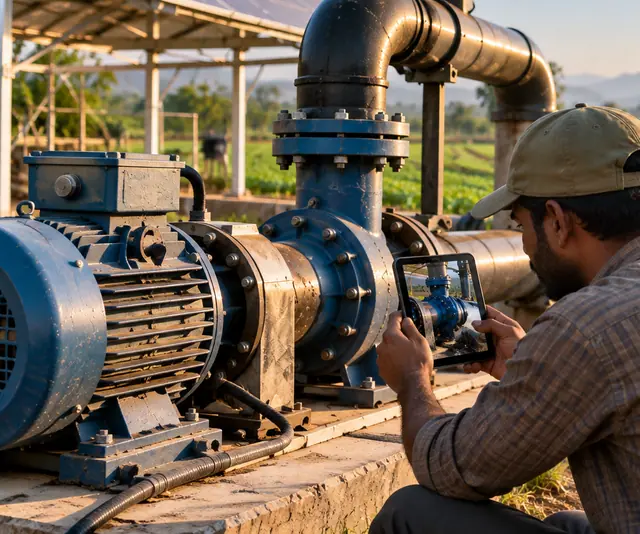
An asset becomes more understandable as its context accumulates.
Follow one irrigation pump from the moment it is identified to the moment a decision about it is recorded — and see how each step makes the next investigation better informed.
Nine stages, one record.
Each stage adds context to the same asset. Nothing is filed separately and nothing is lost between people.
- 01Physical asset
- 02Identity
- 03Knowledge
- 04Evidence
- 05History
- 06Investigation
- 07Recommendation
- 08Human decision
- 09Recorded outcome
Identify, connect, capture, build, investigate, recommend, record.
Scroll to add each layer around the pump.
- 01
Identify
Establish the identity of the physical asset using an Asset Anchor, a nameplate photograph or a serial number — whatever is available.
Adds · Identity - 02
Connect knowledge
Bring together manuals, specifications and relevant technical documents, kept distinct from facts about this unit.
Adds · Knowledge - 03
Capture evidence
Record photographs, readings, observations and notes at the machine, with capture time and author.
Adds · Evidence - 04
Build history
Preserve installation, inspection, service, repair and parts information against the same asset record.
Adds · History - 05
Investigate
Ask asset-specific questions using its connected knowledge and history. Gaps in the record are flagged, not hidden.
Adds · Investigation - 06
Recommend
Present source-grounded possible next steps, with observations and inferences distinguished.
Adds · Recommendation - 07
Record
Capture the confirmed decision and its outcome in the asset’s history, so the record keeps learning.
Adds · Human decision
A scan, a nameplate photo or a serial number.
A label that has faded in the sun should never block the work. Any of these resolves to the same record.
Asset Anchor
A QR code or durable tag on the machine, designed to survive dust, mud, sun and monsoon. One scan opens identity, documents, history and a way to ask a question.
Nameplate photograph
Where there is no readable tag, a photograph of the nameplate is the fallback — same record, same fidelity.
Serial number or name
Search by serial or name from the farm office, a dealer’s workshop or a desktop.
Not every machine can be tagged on day one. Older equipment and second-hand purchases enter with partial history, and the record grows from there.
A concrete example, clearly illustrative.
Source documents, photographs, a previous service event and a representative investigation — all attached to one machine.
Irrigation Pump · Pump House 2
ZIRAT-PM-0000
- Asset type
- Irrigation pump
- Make / model
- Illustrative
- Location
- Pump House 2
- Anchor
- QR tag · nameplate photo on file
Knowledge General equipment knowledge
- Technical manualLinked
- Specification sheetLinked
- Service guideLinked
History Fact from records
- Current yearPre-season check
- Previous yearSeal replaced
- EarlierInstalled
Evidence Observed
Condition Possible seal seepage · Photos 3 · Notes operator-entered
Investigation
Operator asksWhat should I check before the next irrigation cycle?
Today’s photos appear to show seepage near the shaft seal.
A previous service record notes a seal replacement.
The seal may need renewed inspection.
Consult the service guide and have a mechanic inspect the seal before prolonged operation.
Seal part number is not recorded against this asset.
Zirat does not declare the machine safe or operational. The mechanic decides.
Illustrative interaction- SourceA document or record
- ObservedSeen or recorded at this machine
- InferredReasoned — verify
- SuggestedA possible next step
- Human decisionConfirmed by a person
Eight questions, answered progressively.
An asset does not need every answer on day one. A pump with only “what, which and where” answered is still a useful record — and it enriches as knowledge accumulates.
| Question | What it establishes | Agricultural example |
|---|---|---|
| What | What the asset is | A submersible irrigation pump, a walk-in cold store |
| Which | The exact unit, not the category | This pump by make, model, variant and serial number |
| Who | Ownership, operators, service relationships | Owning farm, assigned operator, servicing dealer or mechanic |
| Where | Physical and organisational location | Farm → pump house, or a specific polyhouse |
| When | Time-bound facts across its life | Purchase, last service, warranty expiry, next maintenance |
| Why | Operational purpose | Irrigation, cooling, storage, power generation |
| How | Operating and maintenance knowledge | Start-up procedure, service intervals, known failure patterns |
| So what | The decision implication | Whether this pump is fit for the next cycle, or needs a check first |
The relationship spans the machine’s operating life, not one onboarding.
- 01AcquisitionBought, leased or brought on to the operation
- 02AnchoringBound to its Asset Anchor
- 03Knowledge ingestionManuals, specifications, warranty and purchase records attached
- 04Active useDeployed for irrigation, cooling, harvest or transport
- 05Service eventsEach event joins the history, not a ticket that disappears
- 06InvestigationQuestions asked across the machine’s life
- 07TransferOwnership or site changes — identity persists
- 08RetirementThe record is closed out, not deleted
A manager who joins mid-season, or a mechanic who has never seen this pump, inherits its documented history instead of starting from zero.